Tag: ssh

  • Quick Tip: Add Screen Name to Bash Prompt

    Quick Tip: Add Screen Name to Bash Prompt

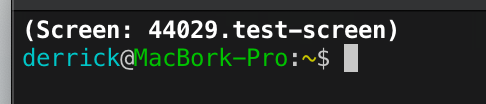
    I often SSH into servers to get some work done, and one of the things I discovered recently is that I may not always know or remember if I’m in a screen session.

    So I had the bright idea to just add it to my shell prompt!

    Simply just add one of these to your RC file of choice:

    Bash

    # Add Screen name to PS1 if we're in a screen.
    if [ -n "$STY" ]; then
    	PS1="\[\e[1m\](Screen: $STY)\[\e[0m\]\n$PS1"
    fiCode language: PHP (php)

    ZSH

    # Add Screen name to PROMPT if we're in a screen.
    if [[ -n "$STY" ]]; then
    	PROMPT="%B(Screen: $STY)%b"$'\n'"$PROMPT"
    fiCode language: PHP (php)

    And remember, if you’re asking yourself if you should run something in a screen, you’re already too late!

  • Open source ngrok alternative

    Open source ngrok alternative

    During a client onsite last year, I was first introduced to ngrok. Ngrok provides “secure introspectable tunnels to localhost.” The free tier of ngrok provides temporary, random subdomains to use. This is fine most of the time, but kind of causes problems for things like Jetpack that require persistent domain names for connecting.

    While I could shell out the $5/month for the lowest paid tier of ngrok, I would still be limited to a certain number of domains and connections.

    While looking for an alternative to ngrok, I came across sish. Sish is “an open source serveo/ngrok alternative. HTTP(S)/WS(S)/TCP Tunnels to localhost using only SSH.” To be honest, I don’t understand most of those words, but that won’t stop me!

    I of course needed a server somewhere to run this on, so I ran over to DigitalOcean and decided to spend my $5/month on a general purpose VPS instead (Here’s my DigitalOcean referral link if you’re so inclined).

    What follows is my notes I took to install sish and get it up and running. I can’t guarantee they’re perfect, and I don’t feel like deleting my VPS and starting over again just to make sure 🙂 If you see something wrong, feel free to comment me a correction or question.

    Step 1: Make a wildcard subdomain (ex *.sish.example.com)

    Step 2: Set up a DigitalOcean droplet.

    Step 3. Log in and run:

    # Make a house a home
    echo "export PS1=\"\\[\\033[38;5;33m\\]\\u\\[\$(tput sgr0)\\]\\[\\033[38;5;11m\\]@\\[\$(tput sgr0)\\]\\[\\033[38;5;33m\\]\\H\\[\$(tput sgr0)\\]\\[\\033[38;5;15m\\]:\\[\$(tput sgr0)\\]\\[\\033[38;5;11m\\]\\w\\[\$(tput sgr0)\\]\\[\\033[38;5;15m\\]\\\\$ \\[\$(tput sgr0)\\]\"" >> ~/.bashrc
    source ~/.bashrc
    apt update
    apt upgrade
    apt install ack-grep mc byobu git curl locate
    updatedb
    
    # Security
    ufw allow http
    ufw allow https
    ufw allow ssh
    ufw allow 2222
    ufw --force enable
    apt install fail2ban
    
    # Create swapfile
    fallocate -l 1G /swapfile
    chmod 600 /swapfile
    mkswap /swapfile
    swapon /swapfile
    echo '/swapfile none swap sw 0 0' | tee -a /etc/fstab
    
    # Install Docker
    apt install apt-transport-https ca-certificates curl gnupg-agent software-properties-common
    curl -fsSL https://download.docker.com/linux/ubuntu/gpg | sudo apt-key add -
    add-apt-repository "deb [arch=amd64] https://download.docker.com/linux/ubuntu/ $(lsb_release -cs) stable"
    apt update
    apt install docker-ce docker-ce-cli containerd.io
    
    # Install Certbot
    certbot-auto certonly --manual -d *.sish.example.com --agree-tos --no-bootstrap --preferred-challenges dns-01 --server https://acme-v02.api.letsencrypt.org/directory
    certbot certonly –manual -d *.sish.example.com –agree-tos –no-bootstrap –manual-public-ip-logging-ok –preferred-challenges dns-01 –server https://acme-v02.api.letsencrypt.org/directory
    
    # Install Keys
    curl https://github.com/my_github_username.keys > ~/sish/pubkeys/my_github_username
    cp -f /etc/letsencrypt/live/sish.example.com-0001/* ~/sish/ssl/
    ssh-keygen
    ln -s ~/.ssh/id_rsa ~/sish/ssh_key
    
    # Run Sish
    cat << "EOF" > /root/sish/docker-start.sh
    /usr/bin/docker run --name sish \
      -v ~/sish/ssl:/ssl \
      -v ~/sish/keys:/keys \
      -v ~/sish/pubkeys:/pubkeys \
      --restart unless-stopped \
      --net=host antoniomika/sish:latest \
      -sish.addr=sish.example.com:2222 \
      -sish.adminenabled=true \
      -sish.auth=false \
      -sish.bindrandom=false \
      -sish.domain=sish.example.com \
      -sish.forcerandomsubdomain=false \
      -sish.http=:80 \
      -sish.https=:443 \
      -sish.httpsenabled=true \
      -sish.httpspems=/ssl \
      -sish.keysdir=/pubkeys \
      -sish.pkloc=/keys/ssh_key \
      -sish.redirectrootlocation=https://example.com/ \
      -sish.serviceconsoleenabled=true
    EOF
    
    cat << EOF > /etc/systemd/system/docker-sish.service
    # Thanks to https://blog.container-solutions.com/running-docker-containers-with-systemd
    
    [Unit]
    Description=Sish container
    Requires=docker.service
    After=docker.service
    
    [Service]
    TimeoutStartSec=0
    Restart=always
    ExecStartPre=-/usr/bin/docker stop sish
    ExecStartPre=-/usr/bin/docker rm sish
    ExecStartPre=/usr/bin/docker pull antoniomika/sish:latest
    ExecStart=/bin/bash /root/sish/docker-start.sh
    ExecStop=/usr/bin/docker stop sish
    RemainAfterExit=true
    
    [Install]
    WantedBy=default.target
    EOF
    
    systemctl enable docker-sish
    systemctl start docker-sishCode language: PHP (php)

    From here, I can now set up a shortcut program to run locally to start a tunnel:

    cat << "EOF" > /usr/local/bin/sish
    #/bin/bash
    ssh -p 2222 -R $1:80:localhost:80 root@sish.example.com
    EOF
    chmod +x /usr/local/bin/sishCode language: PHP (php)

  • Windows, SFTP, and the Registry

    Windows, SFTP, and the Registry

    One of the tasks that I have to do often at work is copying data to and from an SFTP directory.  Previously I had a constant domain and port that I was able to connect to, an I could save this in a WinSCP profile for ease of use.  Due to some recent architectural changes though, we’re now dynamically generating IPs and ports to connect to, which caused a bit of a headache.  Luckily though, we do get a really nice sftp://user@domain.example.com:1234 URI that gives us this information, and some terminal clients even allow you to click it (ConEmu).

    Unfortunately, I can’t just register WinSCP as the default handler for sftp URIs because I needed to provide other data, such as a private key and proxy information.

    To fix this,  I created a wrapper, poorly named scp.cmd that does all of this work:

    @echo off
    :: Set some necessary path variables.
    :: I would recommend WinSCP Portable, but that's just me.
    set WINSCP_PATH="C:\Path To\winscp.exe"
    set PRIVKEY_PPK="C:\Path To\Private Key.ppk"
    :: Run the actual SCP command.
    %WINSCP_PATH% %1 /privatekey=%PRIVKEY_PPK% /rawsettings ProxyMethod=2 ProxyHost="127.0.0.1" ProxyPort=8080
    :: Unset the variables now that we don't need them.
    set WINSCP_PATH=
    set PRIVKEY_PPK=Code language: PHP (php)

    From here I can create a Windows Registry file (or manually do it with regedit.exe but that’s crazy) to register the sftp URI handler and point it to my scp.cmd file:

    Windows Registry Editor Version 5.00
    
    [HKEY_CLASSES_ROOT\sftp\shell\open\command]
    @="\"C:\\Windows\\scp.cmd\" \"%1\""Code language: JavaScript (javascript)

    Now I can easily click on sftp links for work, I can paste them into the Windows Run dialog, or even open them via the command line with start.  This is a wonderful time saver!