Tag: wordpress

  • Debugging WordPress Hooks: Speed

    Debugging WordPress Hooks: Speed

    If you google debugging WordPress hooks you’ll find a lot of information.

    About 1,180,000 results

    Let’s add another one.

    WordPress hooks are powerful, but also complex under the hood. There’s plenty of topics I could talk about here, but right now I’m only going to talk about speed. How long does it take for a hook to fire and return?

    Some cool work in this area has already been done thanks to Debug Bar Slow Actions and Query Monitor, but outside of something like Xdebug or New Relic, you’ll have a hard time figuring out how long each individual hook callback takes without modifying either WordPress core or each hook call.

    … or maybe not …

    While doing some client debugging for my job at WordPress VIP (did I mention we’re hiring?) I came across the need to do this exact thing. I’ve just finished the code that will make this happen, and I’m releasing it into the wild for everyone to benefit.

    What’s the problem we’re trying to solve? Well, this client has a sporadic issue where posts saving in the admin time out and sometimes fail. We’ve ruled out some potential issues, and are looking at a save_post hook going haywire.

    Now I can capture every single save_post action, what the callback was, and how long it took. Here’s an example for this exact post:

    START: 10:save_post, (Callback: `delete_get_calendar_cache`)
    STOP: 10:save_post, Taken 132.084μs (Callback: `delete_get_calendar_cache`)
    START: 10:save_post, (Callback: `sharing_meta_box_save`)
    STOP: 10:save_post, Taken 15.974μs (Callback: `sharing_meta_box_save`)
    START: 10:save_post, (Callback: `Jetpack_Likes_Settings::meta_box_save`)
    STOP: 10:save_post, Taken 19.073μs (Callback: `Jetpack_Likes_Settings::meta_box_save`)
    START: 10:save_post, (Callback: `SyntaxHighlighter::mark_as_encoded`)
    STOP: 10:save_post, Taken 19.073μs (Callback: `SyntaxHighlighter::mark_as_encoded`)
    START: 10:save_post, (Callback: `AMP_Post_Meta_Box::save_amp_status`)
    STOP: 10:save_post, Taken 16.928μs (Callback: `AMP_Post_Meta_Box::save_amp_status`)
    START: 20:save_post, (Callback: `Publicize::save_meta`)
    STOP: 20:save_post, Taken 428.915μs (Callback: `Publicize::save_meta`)
    START: 9000:save_post, (Callback: `Debug_Bar_Slow_Actions::time_stop`)
    STOP: 9000:save_post, Taken 11.921μs (Callback: `Debug_Bar_Slow_Actions::time_stop`)
    START: 1:save_post, (Callback: `The_SEO_Framework\Load::_update_post_meta`)
    STOP: 1:save_post, Taken 6.016ms (Callback: `The_SEO_Framework\Load::_update_post_meta`)
    START: 1:save_post, (Callback: `The_SEO_Framework\Load::_save_inpost_primary_term`)
    STOP: 1:save_post, Taken 1.535ms (Callback: `The_SEO_Framework\Load::_save_inpost_primary_term`)
    START: 10:save_post, (Callback: `delete_get_calendar_cache`)
    STOP: 10:save_post, Taken 179.052μs (Callback: `delete_get_calendar_cache`)
    START: 10:save_post, (Callback: `sharing_meta_box_save`)
    STOP: 10:save_post, Taken 247.002μs (Callback: `sharing_meta_box_save`)
    START: 10:save_post, (Callback: `Jetpack_Likes_Settings::meta_box_save`)
    STOP: 10:save_post, Taken 25.988μs (Callback: `Jetpack_Likes_Settings::meta_box_save`)
    START: 10:save_post, (Callback: `The_SEO_Framework\Load::delete_excluded_ids_cache`)
    STOP: 10:save_post, Taken 185.966μs (Callback: `The_SEO_Framework\Load::delete_excluded_ids_cache`)
    START: 10:save_post, (Callback: `SyntaxHighlighter::mark_as_encoded`)
    STOP: 10:save_post, Taken 15.020μs (Callback: `SyntaxHighlighter::mark_as_encoded`)
    START: 10:save_post, (Callback: `AMP_Post_Meta_Box::save_amp_status`)
    STOP: 10:save_post, Taken 12.875μs (Callback: `AMP_Post_Meta_Box::save_amp_status`)
    START: 20:save_post, (Callback: `Publicize::save_meta`)
    STOP: 20:save_post, Taken 377.893μs (Callback: `Publicize::save_meta`)
    START: 9000:save_post, (Callback: `Debug_Bar_Slow_Actions::time_stop`)
    STOP: 9000:save_post, Taken 14.067μs (Callback: `Debug_Bar_Slow_Actions::time_stop`)Code language: CSS (css)

    So how does it work?

    1. We add an all action that will fire for every other action.
    2. In the all callback, we make sure we’re looking for the correct hook.
    3. We then build an array to store some data, use the $wp_filter global to fill out information such as the priority and the callback, and store the start time.
    4. Next we have to add a new action to run for our hook right before the callback we want to time. We use the fact that, even though add_action() is supposed to use an int for the priority, it will also accept a string. We add new hooks, and re-prioritze all of the existing hooks with floats that are stringified.
    5. This allows us to capture the start time and end time of each individual callback, instead of the priority group as a whole.

    Of course, this does add a tiny bit of overhead, and could cause some problems if any other plugins use stringified hook priorities, or other odd issues–so be careful 🙂

    Finally, here’s the code:

    class VIP_Hook_Timeline {
    	public $hook;
    	public $callbacks     = [];
    	public $callback_mod  = 0.0001;
    	public $callback_mods = [];
    
    	public function __construct( $hook ) {
    		$this->hook = $hook;
    		add_action( 'all', array( $this, 'start' ) );
    	}
    
    	public function start() {
    		// We only want to get a timeline for one hook.
    		if ( $this->hook !== current_filter() ) {
    			return;
    		}
    
    		global $wp_filter;
    
    		// Iterate over each priority level and set up array.
    		foreach( $wp_filter[ $this->hook ] as $priority => $callback ) {
    			// Make the mod counter if not exists.
    			if ( ! isset( $this->callback_mods[ $priority ] ) ) {
    				$this->callback_mods[ $priority ] = $priority - $this->callback_mod;
    			}
    
    			// Make the array if not exists.
    			if ( ! is_array( $this->callbacks[ $priority ] ) ) {
    				$this->callbacks[ $priority ] = [];
    			}
    
    			// Iterate over each callback and set up array.
    			foreach( array_keys( $callback ) as $callback_func ) {
    				if ( ! is_array( $this->callbacks[ $priority ][ $callback_func ] ) ) {
    					$this->callbacks[ $priority ][ $callback_func ] = [ 'start' => 0, 'stop' => 0 ];
    				}
    			}
    		}
    
    		foreach( $this->callbacks as $priority => $callback ) {
    			foreach ( array_keys( $callback ) as $callback_func ) {
    
    				// Get data befmore we move things around.
    				$human_callback = $this->get_human_callback( $wp_filter[ $this->hook ][ $priority ][$callback_func] );
    
    				// Modify the priorities.
    				$pre_callback_priority = $this->callback_mods[ $priority ];
    				$this->callback_mods[ $priority ] = $this->callback_mods[ $priority ] + $this->callback_mod;
    
    				$new_callback_priority = $this->callback_mods[ $priority ];
    				$this->callback_mods[ $priority ] = $this->callback_mods[ $priority ] + $this->callback_mod;
    
    				$post_callback_priority = $this->callback_mods[ $priority ];
    				$this->callback_mods[ $priority ] = $this->callback_mods[ $priority ] + $this->callback_mod;
    
    				// Move the callback to our "new" priority.
    				if ( $new_callback_priority != $priority ) {
    					$wp_filter[ $this->hook ]->callbacks[ strval( $new_callback_priority ) ][ $callback_func ] = $wp_filter[ $this->hook ]->callbacks[ $priority ][ $callback_func ];
    					unset( $wp_filter[ $this->hook ]->callbacks[ $priority ][ $callback_func ] );
    					if ( empty( $wp_filter[ $this->hook ]->callbacks[ $priority ] ) ) {
    						unset( $wp_filter[ $this->hook ]->callbacks[ $priority ] );
    					}
    				}
    
    				// Add a new action right before the one we want to debug to capture start time.
    				add_action( $this->hook, function( $value = null ) use ( $callback_func, $priority, $human_callback ) {
    					$this->callbacks[ $priority ][ $callback_func ]['start'] = microtime( true );
    
    					// Uncomment this if you just want to dump data to the PHP error log, otherwise add your own logic.
    					//$message = 'START: %d:%s, (Callback: `%s`)';
    					// phpcs:ignore WordPress.PHP.DevelopmentFunctions.error_log_error_log
    					//error_log( sprintf( $message,
    					//	$priority,
    					//	$this->hook,
    					//	$human_callback,
    					//) );
    
    					// Just in case it's a filter, return.
    					return $value;
    				}, strval( $pre_callback_priority ) );
    
    				// Add a new action right after the one we want to debug to capture end time.
    				add_action( $this->hook, function( $value = null ) use ( $callback_func, $priority, $human_callback ) {
    					$this->callbacks[ $priority ][ $callback_func ]['stop'] = microtime( true );
    
    					// Uncomment this if you just want to dump data to the PHP error log, otherwise add your own logic.
    					//$message = 'STOP: %d:%s, Taken %s (Callback: `%s`)';
    					// phpcs:ignore WordPress.PHP.DevelopmentFunctions.error_log_error_log
    					//error_log( sprintf( $message,
    					//	$priority,
    					//	$this->hook,
    					//	$this->get_human_diff( $priority, $callback_func ),
    					//	$human_callback,
    					//) );
    
    					// Just in case it's a filter, return.
    					return $value;
    				}, strval( $post_callback_priority ) );
    				
    			}
    		}
    	}
    
    	public function get_human_callback( $callback ) {
    		$human_callback = '[UNKNOWN HOOK]';
    		if ( is_array( $callback['function'] ) && count( $callback['function'] ) == 2 ) {
    			list( $object_or_class, $method ) = $callback['function'];
    			if ( is_object( $object_or_class ) ) {
    				$object_or_class = get_class( $object_or_class );
    			}
    			$human_callback =  sprintf( '%s::%s', $object_or_class, $method );
    		} elseif ( is_object( $callback['function'] ) ) {
    			// Probably an anonymous function.
    			$human_callback =  get_class( $callback['function'] );
    		} else {
    			$human_callback =  $callback['function'];
    		}
    		return $human_callback;
    	}
    
    	public function get_start( $priority, $callback_func ) {
    		return (float) $this->callbacks[ $priority ][ $callback_func ]['start'];
    	}
    
    	public function get_stop( $priority, $callback_func ) {
    		return (float) $this->callbacks[ $priority ][ $callback_func ]['stop'];
    	}
    
    	public function get_diff( $priority, $callback_func ) {
    		return (float) ( $this->get_stop( $priority, $callback_func ) - $this->get_start( $priority, $callback_func ) );
    	}
    
    	public function get_human_diff( $priority, $callback_func ) {
    		$seconds = $this->get_diff( $priority, $callback_func );
    
    		// Seconds.
    		if ( $seconds >= 1 || $seconds == 0 ) {
    			return number_format( $seconds, 3 ) . 's';
    		}
    
    		// Milliseconds.
    		if ( $seconds >= .001 ) {
    			return number_format( $seconds * 1000, 3 ) . 'ms';
    		}
    
    		// Microseconds.
    		if ( $seconds >= .000001 ) {
    			return number_format( $seconds * 1000000, 3 ) . 'μs';
    		}
    
    		// Nanoseconds.
    		if ( $seconds >= .000000001 ) {
    			// WOW THAT'S FAST!
    			return number_format( $seconds * 1000000000, 3 ) . 'ns';
    		}
    
    		return $seconds . 's?';
    	}
    }
    new VIP_Hook_Timeline( 'save_post' );Code language: PHP (php)


  • Better Caching in WordPress

    Better Caching in WordPress

    Caching data in WordPress is easy. Caching data in WordPress in a good and performant way takes a bit more work. For instance, many developers commonly use the Transients API to cache data. As the lowest common denominator in caching, this is okay. It’ll get the job done, even on a $10/year shared hosting plan. But what we should do instead is leverage the WP_Object_Cache functions to provide more functionality and better features.

    For instance, let’s say we want to cache the result of an external API request. One way we could do this would be this way:

    Note: These examples are terrible, but I hope they get the point across!

    function get_api( $value) {
    	$value = absint( $value );
    	$api_data = get_transient( 'example-api-data-' . $value );
    
    	if ( false === $api_data ) {
    		$api_data = file_get_contents( 'https://example.com/api/' . $value );
    		set_transient( 'example-api-data-' . $value, $api_data, HOUR_IN_SECONDS * 6 );
    	}
    
    	return json_decode( $api_data );
    }Code language: PHP (php)

    What’s one way we could make this better by using the WP_Object_Cache functions? Well, what happens if the API data structure changes, and you need to invalidate every cache value? It would be pretty hard to know the exact transient keys that you’d need to clear, and clearing the entire cache is a bit too nuclear for this (but it would work). Instead, wp_cache_*() could be used, which includes the ability to use a cache group that can be changed:

    function get_api( $value) {
    	$value = absint( $value );
    	$cache_group = 'example-api-data';
    
    	$api_data = wp_cache_get( $value, $cache_group );
    
    	if ( false === $api_data ) {
    		$api_data = file_get_contents( 'https://example.com/api/' . $value );
    		wp_cache_set( $value, $api_data, $cache_group, HOUR_IN_SECONDS * 6 );
    	}
    
    	return json_decode( $api_data );
    }Code language: PHP (php)

    With this, if we ever need to invalidate the cache for this API, we just need to change the $cache_group value, and all cache requests will be new.


    Another common theme I see is caching too much data. Let’s say you’re going to do a slow WP_Query, and want to cache the results for better performance:

    function get_new_posts() {
    	$posts = wp_cache_get( 'new-posts' );
    
    	if ( false === $posts ) {
    		$posts = new WP_Query( 'posts_per_page=5000' );
    		wp_cache_set( 'new-posts', $posts );
    	}
    
    	return $posts;
    }Code language: PHP (php)

    Sure, that’s fine and it’ll work but… the WP_Query object is huge!

    echo strlen( serialize( new WP_Query( 'posts_per_page=500' ) ) ); … 2,430,748

    That’s 2.5 megs of data needing to be transferred out of cache on every pageload. If your cache is accessed across the network on another server, this introduces more delay as it has to transfer. Also, some caching solutions might put a limit on the size of an individual cache object–which means that an object like this might never be cached!

    Instead, we can just grab the IDs of the posts, and do a second, much faster query:

    function get_new_posts() {
    	$post_ids = wp_cache_get( 'new-posts' );
    
    	if ( false === $posts ) {
    		$post_ids = new WP_Query( 'posts_per_page=5000&fields=ids' );
    		wp_cache_set( 'new-posts', $posts->posts );
    	}
    
    	$posts = new WP_Query( [ 'post__in' => $post_ids ] );
    
    	return $posts;
    }Code language: PHP (php)

    echo strlen( serialize( $posts->posts ) ); … only 88,838 bytes, that’s like a 96%-something difference!

    I had a few more ideas for this post, but it’s been sitting as a draft forever and I don’t remember. It’s possible this topic might be revisited some day 🙂

  • Page Generation Graph for WordPress

    Page Generation Graph for WordPress

    At work, one of the more interesting customizations we have on WordPress.com for our VIP clients is a dashboard that contains custom widgets.  One of them is a page generation graph that shows the average page generation time for their site compared to all others.  That way they can judge their code performance against a good baseline.

    (more…)
  • Quick Tip: DreamHost cron and WP-CLI

    Quick Tip: DreamHost cron and WP-CLI

    If you’re hosting your WordPress website on DreamHost, and use their cron system to offload your WordPress faux-cron for better reliability, be careful of what version of PHP you have in your code.

    I recently had an issue where my cron events weren’t firing, and after enabling email output, I ended up with something like this PHP error message:

    Parse error: syntax error, unexpected '?' in /path/to/file.php on line 123

    It turns out that WP-CLI was running PHP 5.x via the DreamHost cron system.  I had PHP 7.x specific code in my theme.
    To fix this, I had to set the WP_CLI_PHP environment variable in my cron job:

    export WP_CLI_PHP=/usr/local/php72/bin/php
    wp cron event run --due-now --path=/home/path/to/wp/ --url=https://example.com/Code language: JavaScript (javascript)
  • Logging Failed Redirects

    Logging Failed Redirects

    WordPress has a built-in function called wp_safe_redirect().  This allows you to create redirects in code, but only to whitelisted domains (via the allowed_redirect_hosts filter).

    The downside to this is that you have to remember to whitelist the domains.  It’s easy to forget if you’re doing a lot of redirects, for instance with the WPCOM Legacy Redirector plugin.

    When this happens, all un-whitelisted redirects will be redirected by default to /wp-admin/ instead, and can cause a headache trying to figure out what’s going wrong.

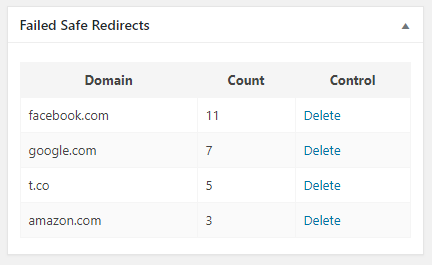
    I had an idea to solve this problem.  A simple logging plugin that logs failed redirects and adds a dashboard widget to show the domains and number of times the redirect has failed:

    The code behind this:

    <?php
    class Emrikol_WSRD_Dashboard {
    	public static function instance() {
    		static $instance = false;
    		if ( ! $instance ) {
    			$instance = new Emrikol_WSRD_Dashboard();
    		}
    		return $instance;
    	}
    
    	public function __construct() {
    		add_action( 'init', array( $this, 'init' ) );
    		add_filter( 'allowed_redirect_hosts', array( $this, 'check_redirect' ), PHP_INT_MAX, 2 );
    	}
    
    	public function init() {
    		if ( $this->is_admin() && isset( $_GET['wsrd_delete'] ) && check_admin_referer( 'wsrd_delete' ) && isset( $_GET['ID'] ) ) {
    			$post_id = (int) $_GET['ID'];
    
    			if ( 'wsrd' !== get_post_type( $post_id ) ) {
    				// This isn't the right post type, abort!
    				add_action( 'admin_notices', array( $this, 'message_log_not_deleted' ) );
    				return;
    			}
    
    			$delete = wp_delete_post( $post_id, true );
    			wp_cache_delete( 'wsrd_report' );
    
    			if ( $delete ) {
    				add_action( 'admin_notices', array( $this, 'message_log_deleted' ) );
    			} else {
    				add_action( 'admin_notices', array( $this, 'message_log_not_deleted' ) );
    			}
    		}
    
    		$args = array(
    			'supports' => array( 'title' ),
    			'public'   => false,
    		);
    		register_post_type( 'wsrd', $args );
    
    		add_action( 'wp_dashboard_setup', array( $this, 'add_dashboard_widgets' ) );
    	}
    
    	public function add_dashboard_widgets() {
    		if ( $this->is_admin() ) {
    			wp_add_dashboard_widget( 'emrikol_wsrd_dashboard', 'Failed Safe Redirects', array( $this, 'show_admin_dashboard' ) );
    		}
    	}
    
    	public function check_redirect( $allowed_hosts, $redirect_host ) {
    		if ( ! in_array( $redirect_host, $allowed_hosts, true ) ) {
    			// No redirect, please record.
    			$found_host = new WP_Query( array(
    				'fields'                 => 'ids',
    				'name'                   => md5( $redirect_host ),
    				'post_type'              => 'wsrd',
    				'post_status'            => 'any',
    				'no_found_rows'          => true,
    				'posts_per_page'         => 1,
    				'update_post_term_cache' => false,
    				'update_post_meta_cache' => false,
    			) );
    
    			if ( empty( $found_host->posts ) ) {
    				// No past redirect log found, create one.
    				$args   = array(
    					'post_name'  => md5( $redirect_host ),
    					'post_title' => $redirect_host,
    					'post_type'  => 'wsrd',
    					'meta_input' => array(
    						'count' => 1,
    					),
    				);
    				$insert = wp_insert_post( $args );
    			} else {
    				// Found!  Update count.
    				$count = absint( get_post_meta( $found_host->posts[0], 'count', true ) );
    				$count++;
    				update_post_meta( $found_host->posts[0], 'count', $count );
    			}
    		}
    		// We don't want to modify, always return allowed hosts unharmed.
    		return $allowed_hosts;
    	}
    
    	public function show_admin_dashboard() {
    		global $wpdb;
    
    		$report = wp_cache_get( 'wsrd_report' );
    		if ( false === $report ) {
    			$report = $wpdb->get_results( "SELECT ID, post_title AS host, meta_value AS count FROM $wpdb->posts LEFT JOIN $wpdb->postmeta ON ( $wpdb->posts.ID = $wpdb->postmeta.post_id ) WHERE post_type='wsrd'  ORDER BY ABS( count ) DESC LIMIT 20;" );
    			wp_cache_set( 'wsrd_report', $report, 'default', MINUTE_IN_SECONDS * 5 );
    		}
    
    		?>
    		<style>
    			table#wsrd {
    				border-collapse: collapse;
    				width: 100%;
    			}
    			table#wsrd th {
    				background: #f5f5f5;
    			}
    
    			table#wsrd th, table#wsrd td {
    				border: 1px solid #f5f5f5;
    				padding: 8px;
    			}
    
    			table#wsrd tr:nth-child(even) {
    				background: #fafafa;
    			}
    		</style>
    		<div class="activity-block">
    			<?php if ( empty( $report ) ) : ?>
    			<p><strong>None Found!</strong></p>
    			<?php else : ?>
    			<table id="wsrd">
    				<thead>
    					<tr>
    						<th>Domain</th>
    						<th>Count</th>
    						<th>Control</th>
    					</tr>
    				</thead>
    				<tbody>
    					<?php foreach ( $report as $line ) : ?>
    						<tr>
    							<td><?php echo esc_html( $line->host ); ?></td>
    							<td><?php echo esc_html( $line->count ); ?></td>
    							<td><a href="<?php echo esc_url( wp_nonce_url( add_query_arg( array( 'wsrd_delete' => true, 'ID' => rawurlencode( $line->ID ) ), admin_url() ), 'wsrd_delete' ) ); ?>">Delete</a></td>
    						</tr>
    					<?php endforeach; ?>
    				</tbody>
    			</table>
    			<?php endif; ?>
    		</div>
    		<?php
    	}
    
    	public function message_log_deleted() {
    		echo '<div id="message" class="notice notice-success is-dismissible"><p>Redirect log deleted!</p></div>';
    	}
    
    	public function message_log_not_deleted() {
    		echo '<div id="message" class="notice notice-error is-dismissible"><p>Redirect log delete failed!</p></div>';
    	}
    
    
    	private function is_admin() {
    		if ( current_user_can( 'manage_options' ) ) {
    			return true;
    		}
    		return false;
    	}
    }
    Emrikol_WSRD_Dashboard::instance();
    Code language: HTML, XML (xml)

  • Purging All The Caches!

    Purging All The Caches!

    One of the best ways to ensure that a WordPress site–well any site really–stays performant and not broken is by leveraging caching.

    WordPress by default doesn’t do much caching other than some in-memory caching of objects, and the odd database caching via the Transients API.

    This site currently has three layers of caching:

    This means I have three different plugins that I have to manage with these caches:

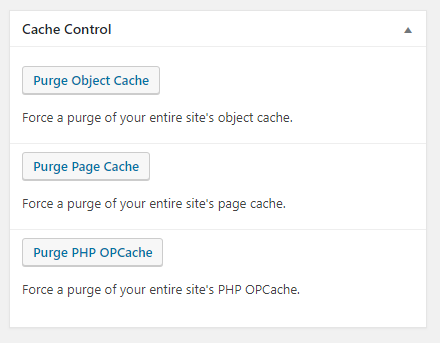
    So if I am doing some development and want to purge one or more caches, I need to go dig around three different places to purge these, and that’s not fun.  To help combat this, I made myself a simple Admin Dashboard widget with quick access to purge each of these:

    Here’s the code:

    <?php
    class Emrikol_Cache_Dashboard {
    	public static function instance() {
    		static $instance = false;
    		if ( ! $instance ) {
    			$instance = new Emrikol_Cache_Dashboard();
    		}
    		return $instance;
    	}
    
    	public function __construct() {
    		add_action( 'init', array( $this, 'init' ) );
    	}
    
    	public function init() {
    		if ( $this->is_admin() && isset( $_GET['ead_purge_object_cache'] ) && check_admin_referer( 'manual_purge' ) ) {
    			$did_flush = wp_cache_flush();
    			if ( $did_flush ) {
    				add_action( 'admin_notices', array( $this, 'message_object_cache_purge_success' ) );
    			} else {
    				add_action( 'admin_notices', array( $this, 'message_object_cache_purge_failure' ) );
    			}
    		} elseif ( $this->is_admin() && isset( $_GET['ead_purge_wp_super_cache'] ) && check_admin_referer( 'manual_purge' ) ) {
    			global $file_prefix;
    			wp_cache_clean_cache( $file_prefix, true );
    			add_action( 'admin_notices', array( $this, 'message_wp_super_cache_purge_success' ) );
    		} elseif ( $this->is_admin() && isset( $_GET['ead_purge_OPcache'] ) && check_admin_referer( 'manual_purge' ) ) {
    			// Taken from: https://wordpress.org/plugins/flush-opcache/
    			// Check if file cache is enabled and delete it if enabled.
    			// phpcs:ignore WordPress.VIP.FileSystemWritesDisallow.file_ops_is_writable
    			if ( ini_get( 'OPcache.file_cache' ) && is_writable( ini_get( 'OPcache.file_cache' ) ) ) {
    				$files = new RecursiveIteratorIterator( new RecursiveDirectoryIterator( ini_get( 'OPcache.file_cache' ), RecursiveDirectoryIterator::SKIP_DOTS ), RecursiveIteratorIterator::CHILD_FIRST );
    				foreach ( $files as $fileinfo ) {
    					$todo = ( $fileinfo->isDir() ? 'rmdir' : 'unlink' );
    					$todo( $fileinfo->getRealPath() );
    				}
    			}
    
    			// Flush OPcache.
    			$did_flush = OPcache_reset();
    			if ( $did_flush ) {
    				add_action( 'admin_notices', array( $this, 'message_OPcache_purge_success' ) );
    			} else {
    				add_action( 'admin_notices', array( $this, 'message_OPcache_purge_failure' ) );
    			}
    		}
    
    		add_action( 'wp_dashboard_setup', array( $this, 'add_dashboard_widgets' ) );
    	}
    
    	public function add_dashboard_widgets() {
    		if ( $this->is_admin() ) {
    			wp_add_dashboard_widget( 'emrikol_admin_dashboard', 'Cache Control', array( $this, 'show_admin_dashboard' ) );
    		}
    	}
    
    	public function show_admin_dashboard() {
    		if ( false === get_parent_class( $GLOBALS['wp_object_cache'] ) ) {
    			// Persistent Object Cache detected.
    			?>
    			<div class="activity-block">
    				<span class="button"><a href="<?php echo esc_url( wp_nonce_url( admin_url( '?ead_purge_object_cache' ), 'manual_purge' ) ); ?>"><strong>Purge Object Cache</strong></a></span>
    				<p>Force a purge of your entire site's object cache.</p>
    			</div>
    			<?php
    		} else {
    			// Transients!
    			?>
    			<div class="activity-block">
    				<h3>Transients</h3>
    				<p>Transients cannot currently be removed manually.</p>
    			</div>
    			<?php
    		}
    		if ( function_exists( 'wp_cache_clean_cache' ) ) {
    			// WP Super Cache!
    			?>
    			<div class="activity-block">
    				<span class="button"><a href="<?php echo esc_url( wp_nonce_url( admin_url( '?ead_purge_wp_super_cache' ), 'manual_purge' ) ); ?>"><strong>Purge Page Cache</strong></a></span>
    				<p>Force a purge of your entire site's page cache.</p>
    			</div>
    			<?php
    		}
    		if ( function_exists( 'OPcache_reset' ) ) {
    			// PHP OPcache.
    			?>
    			<div class="activity-block">
    				<span class="button"><a href="<?php echo esc_url( wp_nonce_url( admin_url( '?ead_purge_OPcache' ), 'manual_purge' ) ); ?>"><strong>Purge PHP OPcache</strong></a></span>
    				<p>Force a purge of your entire site's PHP OPcache.</p>
    			</div>
    			<?php
    		}
    	}
    
    	public function message_wp_super_cache_purge_success() {
    		echo '<div id="message" class="notice notice-success is-dismissible"><p>Page Cache purged!</p></div>';
    	}
    
    	public function message_object_cache_purge_success() {
    		echo '<div id="message" class="notice notice-success is-dismissible"><p>Object Cache purged!</p></div>';
    	}
    
    	public function message_object_cache_purge_failure() {
    		echo '<div id="message" class="notice notice-error is-dismissible"><p>Object Cache purge failed!</p></div>';
    	}
    
    	public function message_OPcache_purge_success() {
    		echo '<div id="message" class="notice notice-success is-dismissible"><p>PHP OPcache purged!</p></div>';
    	}
    
    	public function message_OPcache_purge_failure() {
    		echo '<div id="message" class="notice notice-error is-dismissible"><p>PHP OPcache purge failed!</p></div>';
    	}
    
    	private function is_admin() {
    		if ( current_user_can( 'manage_options' ) ) {
    			return true;
    		}
    		return false;
    	}
    }
    Emrikol_Cache_Dashboard::instance();
    Code language: HTML, XML (xml)